


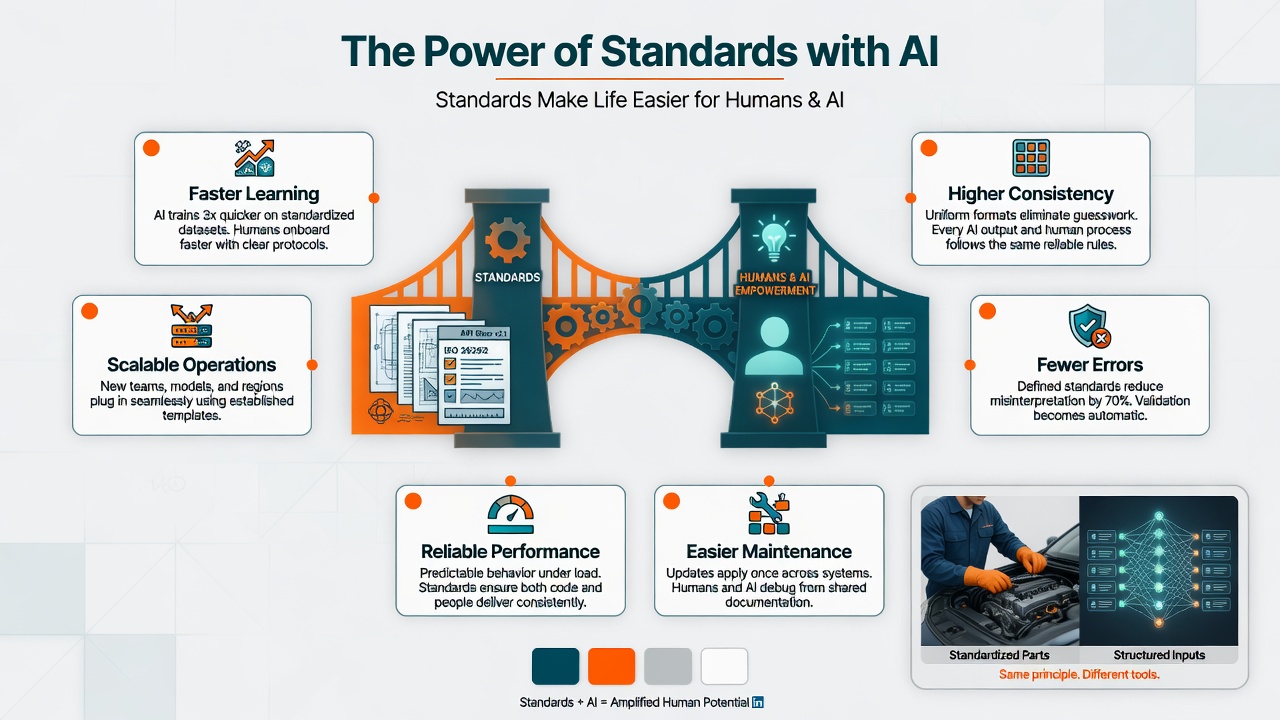
Mechanics build knowledge through hands-on work, reference material, and realistic analysis rather than artistic freedoms.
Car companies design around standardized, reusable parts, making business efficient and maintainable while helping clients find reliable mechanics.
Mechanics learn jobs quickly and perform reliably thanks to standardized parts, catalogs, and manuals across vendors.
Faster learning
Higher consistency
Fewer errors
Easier maintenance
Reliable performance
Scalable operations
Documentation in various forms (written, databases, code, SOPs, workflows, instructions, articles, marketing) preserves standards in large organizations.
It forms the consistent message sent to consumers and teams that maintain or improve products, and must remain uniform across all mediums.
Like a mechanic, strong documentation comes from realistic hands-on work, conventional practices, and thorough investigation.
Consistent messaging
Faster onboarding
Reduced variation
Higher client retention
Higher customer satisfaction
Better client results
Add localization and globalization to the mix in dozens or hundreds of unique markets and languages, and standardization increases in importance exponentially.
When AI is added to operations, effective use mirrors human team members, AI is designed to mimic human reasoning and become a reliable assistant.
Regardless of the context, standardizing source content remains the key to success.
Safer workers & clients
Lower production costs
Higher reliability
Reduced support costs
Increased client satisfaction
Happier legal team